Why Do Ballet Dancers Use a Barre Before Dancing in the Center?
The building blocks behind beautiful ballet. Before the grand jeté comes the tendu.
By Kira Christina
BEAUTIFUL MOVEMENT
Have you ever wondered why we spend so much time at the barre before moving into the center. I’m sure most every young dancer has. After all, they want to get to “the fun stuff!” Years ago my young ballet students asked the question, “since the barre isn’t where the dancing happens in a performance, why do we spend so much of class there.”
Well, one way to think of it is that the barre is where you prepare the body for what you’re about to ask it to do without the safety net of the barre. The exercises may look simple—pliés, tendus, dégagés, rond de jambe, développés, relevés—but they’re doing much more than warming you up. They’re actually rehearsing the ingredients of the bigger movements you’ll eventually take into the center, across the floor, and even onto the stage. A beautifully precise tendu isn’t just a tendu. It’s part of the preparation for steps that require far more coordination, balance, strength, and control, and even working through and articulating that foot!
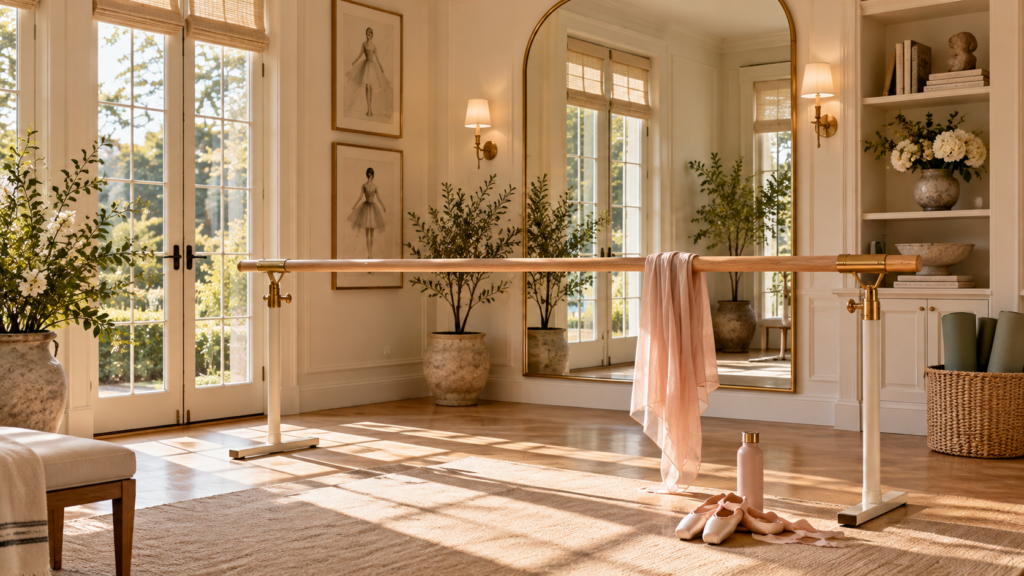
Think of the barre as where you find all of your ballet ingredients. It’s where you get to refine the details before you put all of those details together. So, we shouldn’t rush it. And, I must give a little preview for the kids here… as you get older, you’ll find the time at the barre to be almost meditative. For anyone who’s stepped away from ballet for a bit and come back as an adult, it’s like coming home.
The Barre Is Where the Pieces Come Together
One of the most useful things about barre work is that it allows you to concentrate on one piece of the movement at a time.
You can think about your alignment in a plié. You can pay attention to how your supporting foot feels in a tendu. You can notice whether your knee is tracking over your toes, whether your pelvis is organized, and whether you’re actually using your turnout from the hip rather than simply asking your feet to turn farther.
Then comes the interesting part: those same actions begin appearing in your center work.
A tendu teaches you how to extend the foot and leg while maintaining your placement and engaging the right muscles, not gripping the thighs, etc. Now, we add on. A dégagé adds speed and a little bit of height. Later a grand battement make use of those foundations, and later, that trend battement helps you perform a spectacular grand jeté. A relevé challenges your balance and strength so that you can later balance, dance with a partner, pirouette, and more!
You see that as the class progresses the “ingredients” aren’t isolated anymore. They’re woven together into combinations to create a spectacular recipe, which are later part of your choreography.
And This Is Where That Beautiful Ballet Back Comes In
There’s another reason ballet dancers spend so much time working at the barre: all of that controlled arm, shoulder, and upper-back work adds up, and is why ballet dancers can develop such beautifully defined strong backs. Port de bras isn’t simply about making the arms look pretty. The dancer is continually organizing the shoulders, upper back, ribcage, and spine while moving the arms through different positions, often holding those positions longer than you might expect.
That sustained, controlled work helps explain why dancers can develop such beautifully defined backs and shoulders without relying entirely on traditional weightlifting. Ballet creates resistance through the movement itself. Every time a dancer holds an arm position, slowly moves from first to second, sustains a port de bras, or keeps the upper body organized while the legs are working, the muscles are doing their share of the work.
And because those movements are practiced over and over again, the effect isn’t just about one exercise. It’s the accumulation of thousands of beautifully controlled repetitions. That’s also why the barre matters so much. It gives you a place to practice that control before you have to maintain it while balancing, traveling, jumping, turning, or performing.
Your Jeté Didn’t Just Appear Out of Nowhere
Let’s take a jeté. When you’re learning a small jump, it can be tempting to think of it as simply, Jump, point the feet, land. But your body has already been practicing the pieces of that movement at the barre.
Your pliés have been teaching you how to use the floor and absorb the landing. Your tendus and dégagés have been teaching you to articulate and extend the working leg. Your relevés have been developing strength and balance through the feet and ankles. Your posture and alignment have been practiced over and over again.
Now those ingredients come together in a jump. And then ballet gets even more interesting. That same preparation begins to support an assemblé. A grand jeté asks for even more: greater elevation, traveling through space, coordination of the legs and arms, and the ability to organize the body in the air and land with control.
The steps become more complicated, but the vocabulary underneath them isn’t entirely new.
You’ve been practicing it at the barre all along.
That’s one reason good ballet technique can look almost deceptively simple from the outside. The dancer isn’t inventing each movement from scratch. Years of carefully practiced fundamentals that become muscle memory have been woven into the larger choreography.
Why Your Balance at the Barre Matters
This is also why I love the idea of using the barre as a balance check, rather than treating it as something to lean on. (By the way, if you imagine it’s your partner, you’ll be less tempted to hang on for dear life!).
The barre is a friend, there to help you practice—not to hold you up.
When you’re working at the barre, periodically notice how much weight you’re actually putting into your hand. Your fingers can make contact with the barre, but your body should still be organizing itself as though you were standing independently.
This is especially useful when you’re working on turnout. This is something I think all young students struggle with.
You see your feet in first or fifth position. You notice that someone else’s feet appear to be turned out farther. You think, Surely I can get mine just a little farther. But, if you force your turnout from the knee, rather than the hip, you will not be able to use it in center. And that defeats the purpose!
Teacher’s Tips: Fight the Urge to Force Your Turnout
Turnout is one of those ballet concepts that can look deceptively straightforward. The feet point outward, so it seems logical that you should simply turn the feet outward.
But good turnout comes from the rotation of the legs from the hips, within the range your individual anatomy allows. It isn’t something you want to manufacture by twisting the knees, ankles, or feet into a position your hips aren’t prepared to support.
This is another reason the barre is so valuable.
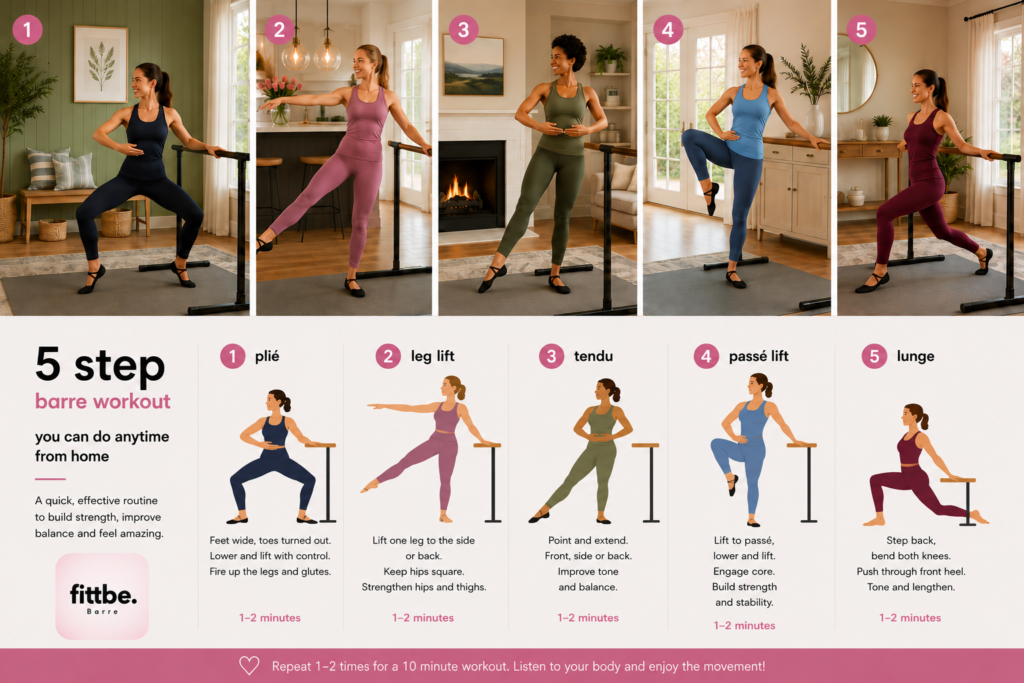
It gives you a chance to check your alignment while you have some support. You can notice whether your knees are tracking in the same direction as your toes, (as we we even say in our Fittbe Barre – not ballet workouts, track that knee over your second toe). The barre can help you check whether your weight is distributed well across the feet, and whether you can maintain your turnout without gripping or twisting.
Sometimes your beautiful fifth position is going to be a little less dramatic than you’d like, and it’s something you just have to come to terms with. A smaller, well-organized position is far more useful than a bigger position you’ve forced.
The reason you shouldn’t force your turnout is because you’re not practicing the shape for the sake of the shape. You’re practicing a position that you eventually need to move from to perform fantastic ballet steps and choreography.
If you force your turnout at the barre, you’re not necessarily preparing yourself for better center work. You’re rehearsing a position that may become difficult—or impossible—to maintain once the support of the barre disappears.
The Barre Is Your Rehearsal for the Center
Think about what happens when you leave the barre.
Suddenly there is nowhere to quietly put your hand while you figure out where your weight is. You have to balance yourself, travel, change direction, coordinate your arms and legs, and remember the combination—all while making it look like you know exactly what you’re doing.
This is where the quality of your barre work begins to pay off.
If you’ve practiced standing tall without collapsing into your supporting hip, that organization comes with you.
If you’ve practiced a controlled plié, you have a better foundation for your jumps.
If you’ve practiced your feet carefully through tendu and dégagé, that articulation becomes part of your traveling steps.
If you’ve practiced relevé without gripping or scrambling for balance, you’re better prepared to find your center when the barre disappears.
And if you’ve learned to respect your natural turnout rather than forcing it, you have a much better chance of maintaining your alignment when you’re moving.
The center doesn’t replace the barre. It reveals what the barre has taught you.
From the Studio to the Stage
A dancer walks onto a stage and performs a variation. We see the jumps, turns, épaulement, port de bras, musicality, and beautiful lines. We don’t see the hundreds of thousands of pliés, tendus, relevés, and carefully practiced transitions that helped build those movements. But they’re there.
The grand jeté contains pieces of the work that came before it. The assemblé contains the preparation of smaller jumps. A turn depends on alignment, balance, spotting, coordination, and strength that have been practiced many times over. The barre isn’t separate from the dancing. It is where the dancing is built.
And that is a useful idea even if you never intend to perform a ballet variation under a spotlight. When you’re practicing Pilates, barre, or ballet-inspired movement at home, the quality of the small movements matters because those are the building blocks from which more complicated movement develops. So the next time you’re at the barre, resist the urge to rush through the “easy” exercises so you can get to the exciting part.
Take your plié seriously. Pay attention to your feet. Check your balance. Let your turnout be yours. Feel where your weight is going. Make the movement clean enough that you could imagine taking it into the center. Because eventually, that’s exactly what you’re going to do!
Keep Exploring Beautiful Movement
If you’re curious about the traditions behind the technique, explore The Great Schools of Ballet: Vaganova, Cecchetti, RAD & Balanchine, Gracie’s Guide to the different schools and traditions that have shaped classical ballet.
And if you’d like to bring some of that same attention to alignment, control, and strength into your own practice, explore the Fittbe Pilates App, where beautiful movement starts with the fundamentals.
Want to Read Later? Be sure to Pin it!