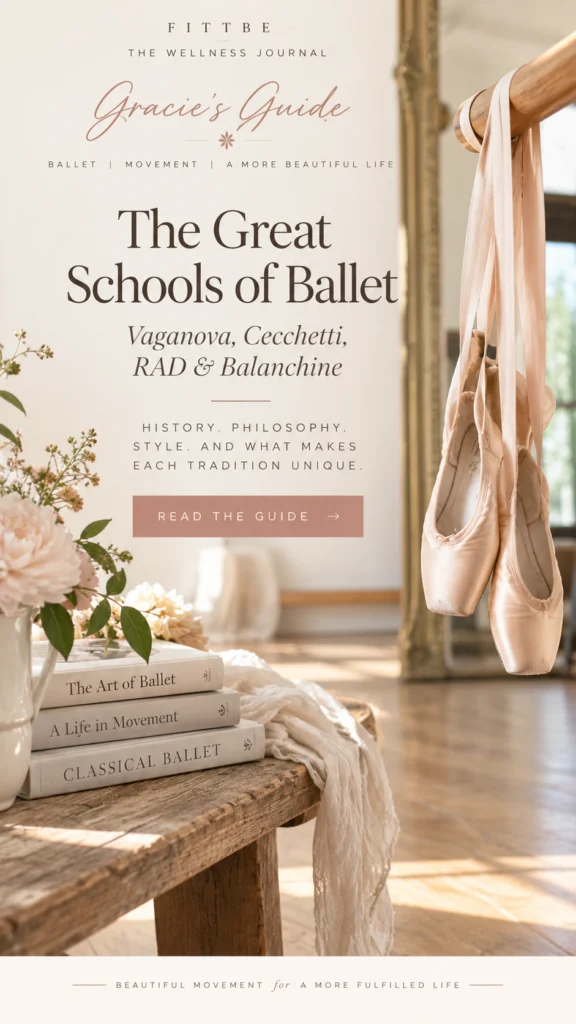
The Great Schools of Ballet
A Gracie’s Guide to Technique, Origins, and How to See the Difference
Vaganova · Cecchetti · Royal Academy of Dance · Balanchine with notes on the French School and Bournonville
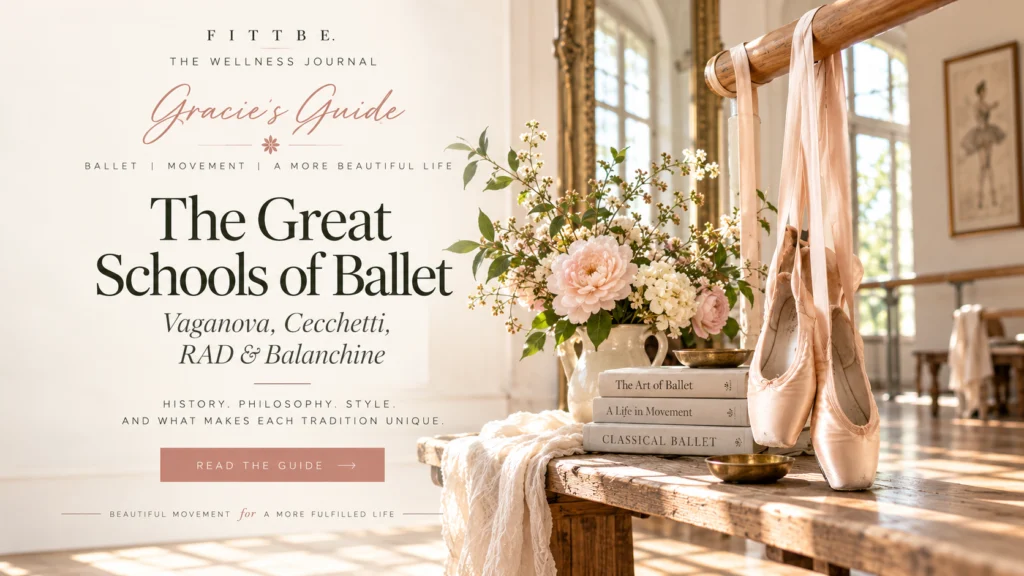
If you have ever watched two beautiful dancers and felt that they were speaking the same language with slightly different accents, you were already noticing technique.
This guide is here to name what you are seeing, celebrate how those differences grew, and give you a confident map of four of the ballet methods students most often encounter: Vaganova, Cecchetti, the Royal Academy of Dance, and Balanchine.
A small spelling kindness before we begin. You will often hear Vaganova written as “Vagonova,” Cecchetti as “Checchetti” or “Chechietti,” and Balanchine as “Balancine.” Those slips are completely common. The names belong to Agrippina Vaganova, Enrico Cecchetti, the Royal Academy of Dance, and George Balanchine. Getting the names right is not pedantry. It is a nice way of honoring the teachers who built the art you love!
One Vocabulary, Many Dialects
Every major classical school teaches a shared vocabulary: the five positions of the feet, plié, tendu, dégagé, rond de jambe, développé, pirouette, and the great families of allegro.
That shared grammar and of course the French language comes from the French court tradition of the seventeenth century. What changes from school to school is the emphasis: how the body is stacked, how the arms speak, how quickly a student is asked to move, whether turnout is treated as a personal anatomical range or an ideal line, and whether class itself is meant to look like dancing or like laboratory work for the stage.
Think of the methods as family members rather than rival teams.
They borrow from one another constantly. Vaganova absorbed Italian virtuosity. RAD was deliberately built from several national traditions. Balanchine was trained in St. Petersburg before carrying that classical foundation to New York and reshaping it for a new kind of choreography.
The French School: The Root of the Tree
Ballet as a codified art begins in France. In 1661, Louis XIV founded the Académie Royale de Danse in Paris. Pierre Beauchamp is traditionally credited with organizing the five positions of the feet that remain foundational to classical ballet.
The French school prized elegance, clarity, épaulement, and quick, articulate footwork. Its influence lives on most visibly in institutions such as the Paris Opera Ballet School.
You do not need to train in Paris to feel this inheritance. Every tendu you do, every French term you speak in class, is a living piece of that courtly beginning. The later methods are not replacements for the French school. They are answers to new stages, new bodies, and new artistic questions that grew from it.
The Cecchetti Method: Purity, Plan, and Anatomy
Origins
Enrico Cecchetti (1850–1928) was born in a theatre dressing room in Rome to two dancers. He studied in the tradition of Carlo Blasis, the great Milanese theorist who had already attempted to make ballet a science as well as an art.
Cecchetti became a celebrated virtuoso and one of the most influential teachers in ballet history. He taught at the Imperial Theatre School in St. Petersburg, coached Anna Pavlova, and later worked with Diaghilev’s Ballets Russes.
In London, with ballet historian Cyril Beaumont and dancer Stanislas Idzikowski, his system was written down in 1922. The Cecchetti Society was founded that same year, helping preserve the method beyond Cecchetti’s own teaching career.
His influence reached generations of dancers and teachers, including Vaslav Nijinsky, Tamara Karsavina, Agrippina Vaganova, Ninette de Valois, Marie Rambert, and Alicia Markova. If English ballet has a technical backbone, much of it runs through Cecchetti.
What the Method Values
Cecchetti wanted technique free of fashionable flourishes. It suggests that movement should be clean, coordinated, and anatomically honest.
Two ideas still feel remarkably modern. First, turnout should grow from the dancer’s own hip rotation rather than from a forced 180-degree ideal. (This one can be hard to instill in students!) Second, class should follow a plan rather than simply the teacher’s mood.
He organized daily work into a rotating cycle so different muscle groups and technical demands could be developed systematically. That is early sports science dressed in a frock coat!
Épaulement—the intelligent turning of the head, shoulders, and torso—is introduced early and used constantly. Port de bras is precise rather than overly sweeping. The goal is a dancer who can move through choreography without carrying an unnecessary personal accent.
How to Recognize It
- Clear, unmannered shapes and a feeling of “nothing extra.”
- Strong coordination of head, arms, and legs.
- Épaulement that looks designed rather than decorative.
- Quick, articulate feet and tidy transitions.
- A classroom culture that values theory as well as execution.
A little encouragement for learners:
If you are the student who loves order, who wants to understand your body rather than simply copy a shape, Cecchetti may feel like a homecoming. It rewards patience and intelligence. You do not have to be the highest jumper in the room to become excellent here. You have to be the most honest one.
The Vaganova Method: Strength Married to Lyricism
Origins
Agrippina Yakovlevna Vaganova (1879–1951) graduated from the Imperial Ballet School in St. Petersburg in 1897 and later became one of the defining teachers of twentieth-century classical ballet.
She retired from the stage in 1916 and devoted herself increasingly to teaching. Her work synthesized elements of Russian, French, and Italian traditions into a progressive approach to classical training. Her landmark book, Fundamentals of Classical Dance, was first published in 1934 and became foundational to the Russian ballet school.
After her death, the Leningrad Choreographic School was named in her honor, and her pedagogical legacy became internationally influential.
There is a lovely connection here: George Balanchine himself was trained in St. Petersburg before eventually carrying that Russian foundation to America.
What the Method Values
Vaganova taught the body as one instrument.
Movement should originate in a stable, expressive torso and travel through the spine into the arms and legs. Port de bras is not decoration laid on top of the steps; it is part of how the movement breathes, how the jump gathers power, and how the turn finds its axis.
She prized aplomb—that vertical steadiness you can already practice in a first-position plié—and she organized training progressively so that skills could arrive when the body was ready to own them.
The resulting quality is often described as both powerful and singing: supported extensions, generous épaulement, arms that breathe, and a back that can feel both steel and silk.
Class combinations tend to be long and logically built. Students are asked not only to do a step, but to understand its purpose.
That intellectual habit is one of Vaganova’s quietest gifts.
How to Recognize It
- Whole-body coordination: head, arms, ribs, and legs arriving together.
- Lyrical, spacious port de bras.
- Generous épaulement and a lifted, expressive torso.
- Amplitude—movement that is large without becoming careless.
- A sense that class is already dancing: phrases feel composed, not merely drilled.
A historical note that helps the eye: Russian and Italian stages were often raked, or sloped upward toward the back. The lifted sternum and engaged upper back associated with Russian classical training make beautiful sense within that architecture. Flat modern stages invite other choices, which is one reason Balanchine eventually looks so different even though he came from the same city.
A little encouragement for learners:
Vaganova can feel slow at the beginning because it refuses to skip the foundations. That slowness is respect. Every clean tendu you do now is money in the bank for the arabesque you want later. Trust the accumulation. You are not behind. You are being built.
The Royal Academy of Dance: A Shared Standard for the World
Origins
RAD is a little different from the other three.
Vaganova, Cecchetti, and Balanchine are associated with particular pedagogical traditions and artistic lineages. RAD is an international teaching and examining organization founded to establish and maintain shared standards.
In 1920, Philip Richardson of The Dancing Times brought together leading dance professionals in London. Adeline Genée became the organization’s first president, and the first syllabus was launched that same year. The first examinations followed in 1921. Queen Mary became its first patron in 1928, and in 1936 the organization became the Royal Academy of Dancing after receiving its Royal Charter.
The founding voices were deliberately international, including Adeline Genée, Tamara Karsavina, Lucia Cormani, Edouard Espinosa, and Phyllis Bedells.
That international beginning matters.
RAD was built from several national traditions and designed to give students a shared, carefully paced pathway through classical ballet.
Today, its graded and vocational pathways are taught internationally.
What the Method Values
Because it was assembled from several traditions, RAD aims for balance rather than extremity.
It asks for sound alignment, musicality, clean vocabulary, and artistry that can develop without rushing the body. The syllabus is progressive: students build one skill before more difficulty is layered on top.
Character dance and free movement sit alongside classical work, so musicality and performance quality are trained rather than postponed until the recital.
It is useful to keep one distinction clear in your mind.
RAD is an examining and teaching organization. It publishes a syllabus and assesses students against it. Vaganova, Balanchine, Bournonville, and the French school are better understood as pedagogical or artistic traditions.
Many wonderful studios combine a method’s aesthetic with an examination board’s structure.
How to Recognize It
- A measured, balanced classicism.
- Clear graded milestones.
- A classroom language built around repeatable fundamentals.
- Attention to musical phrasing and performance quality.
- A blended accent: French precision, Italian clarity, Russian port de bras, and Danish brightness can all be found in its history.
A little encouragement for learners:
RAD is sometimes underestimated because it is so widely available. Wide availability is a triumph, not a compromise. If this is the syllabus in your town, you are not getting a lesser ballet. You are getting a passport. Use the grades as a ladder, not a ceiling.
The Balanchine Technique: Speed, Line, and an American Accent
Origins
Georgi Melitonovich Balanchivadze—George Balanchine (1904–1983)—was trained at the Imperial Theatre School in St. Petersburg before becoming one of the defining choreographers of twentieth-century ballet.
He left the Soviet Union in 1924, joined Diaghilev’s Ballets Russes as a choreographer, and later came to the United States at the invitation of Lincoln Kirstein.
In 1934, Balanchine and Kirstein founded the School of American Ballet in New York. New York City Ballet followed in 1948.
Balanchine did not create a closed academic method in quite the same sense as Cecchetti or Vaganova. Instead, he developed a way of training dancers that would make his neoclassical choreography possible.
At SAB, the technique remains rooted in the Russian classical tradition as refined through Balanchine’s work.
What the Technique Values
If Vaganova often asks the chest to lift and the phrase to sing, Balanchine often asks the body to travel.
Weight sits ready over the balls of the feet. Plié becomes a spring. The heels may kiss the floor rather than settle heavily into it, allowing the dancer to leave again quickly.
Line is stretched toward an athletic extreme: open-hipped arabesques, active hands, and a body that seems perpetually ready to move.
The musical relationship is equally important.
Balanchine’s choreography demands speed, precision, and intense musicality.
Class is preparation for performance, rather than a miniature performance in itself.
How to Recognize It
- Speed and attack.
- Deep, elastic plié.
- A forward poise, ready to move.
- Long, sometimes asymmetrical lines.
- Active hands.
- A bright, syncopated relationship to music.
- The sensation that dancers are riding the score rather than decorating it.
A little encouragement for learners:
Balanchine can look like a closed club from the outside because the professional ideal is so specific. You do not have to have that body, or that career, to learn from the ideas. Deep, honest plié, quick feet, and musical courage can make any dancer more vivid. Take what serves you. Leave the mythology. The work itself is generous if you meet it with energy rather than fear.
Two Neighboring Traditions Worth Knowing
Bournonville: Denmark
August Bournonville (1805–1879) studied in Paris when the French school was still in full bloom, then spent decades as dancer and ballet master of the Royal Danish Ballet.
His style is buoyant, modest in the arms, rich in beaten jumps, and deeply musical. The upper body remains relatively quiet so the brilliance of the feet can speak.
Bournonville also believed dancing should look joyful.
That idea—grace without display—still flavors Danish classicism.
The French School
The French tradition is worth keeping beside Bournonville here because it helps explain just how much of classical ballet is inherited rather than invented anew.
The terminology, positions, épaulement, and many of the basic principles of classical ballet trace back through French theatrical and court traditions.
Why These Traditions Matter to the Four
RAD’s founding group included artists representing several national traditions, including French and Danish influences. Balanchine also had a longstanding interest in Bournonville, and his connection to Danish ballet included a period working with the Royal Danish Ballet before establishing the School of American Ballet.
Nothing in ballet is an island.
Once you know the neighbors, the main four become easier to place.
A Side-by-Side Map
Use this table as a memory assistant, not a cage. Real dancers and real schools mix influences every day.
| Lens | Cecchetti | Vaganova | RAD | Balanchine |
|---|---|---|---|---|
| Born from | Italian tradition, later codified in London | St. Petersburg / Russian tradition | London, as an international examining organization | New York, through SAB |
| Founding figure | Enrico Cecchetti | Agrippina Vaganova | International founding group | George Balanchine |
| Core emphasis | Planned, precise, anatomical technique | Whole-body coordination and lyricism | Progressive, shared classical training | Speed, line, precision, musicality |
| Arms & head | Precise épaulement | Expansive, coordinated, lyrical | Balanced and classical | Active, elongated, sometimes unconventional |
| Lower body | Natural turnout and tidy footwork | Strong support and generous line | Progressive development | Deep plié and rapid footwork |
| Classroom feel | Planned and systematic | Long, composed combinations | Graded progression | Fast, musically demanding |
| Where you’ll encounter it | Cecchetti societies and schools worldwide | Russian-influenced academies worldwide | Studios and exam centers globally | SAB, NYCB, and Balanchine-influenced training |
How the Schools Speak to One Another
It is easy to treat these names as four closed boxes, but they aren’t. Cecchetti taught in St. Petersburg. Vaganova absorbed Italian strength into Russian lyricism. RAD was created from several European traditions. Balanchine carried a St. Petersburg foundation to New York and asked it to move at a new speed.
So when a contemporary class “looks Russian” in the port de bras and “looks American” in the allegro, no one is necessarily doing it wrong. They are standing in a conversation that has been running for generations.
Your job as a student is not to pick a flag. It is to notice what a combination is asking of you today, do that thing fully, and stay curious about the next teacher who asks something else.
A Practical Style Guide for Watching and Training
When You Watch
Start with one question:
Where does the dance live in this body?
If the answer is “in the back and the arms as much as the legs,” you may be seeing qualities associated with Vaganova training.
If the answer is “in the cleanliness of every joint,” look toward Cecchetti.
If the answer is “in clarity and careful musical and technical presentation,” you may be seeing RAD or RAD-influenced training.
If the answer is “in the speed between the steps,” you may be seeing Balanchine-influenced technique.
Then look at the hands and the plié.
Soft, finished fingers and a grounded, singing plié tend toward classical-academic aesthetics. Active fingers and a deep, rebounding plié can signal a more neoclassical approach.
Neither is more correct.
They are different sentences.
When You Train
Learn the house rules of the room you are in.
If the teacher wants a Vaganova port de bras, don’t import a Balanchine hand because you saw it on video last night.
Style-switching is an advanced skill.
First, become fluent in one dialect.
Fluency is what later lets you become bilingual.
Protect the principles that good training has in common: turnout from the hip rather than the knee and ankle, supported alignment, feet that articulate rather than slam, and musical attention.
Those are not one particular method.
Those are craft.
Methods are the art of arranging that craft toward a particular beauty.
If you also teach or take barre, Pilates, or other conditioned movement—as so many dancers and studio owners do—you may already have a head start. You know that a method is only as kind as its progression.
Seeing ballet training through that lens makes the history feel less remote and far more useful.
Closing: You Are Allowed to Love More Than One
The four traditions in this guide grew from different cities, different stages, and different ideas about what a dancer can become.
Cecchetti valued purity and a plan.
Vaganova developed a whole-body approach that could be both powerful and lyrical.
RAD created a shared standard that students around the world could follow.
Balanchine asked classical technique to move with the speed and musicality of a new American stage.
Behind them stands the French school, and beside them stands Bournonville’s bright, unshowy joy.
You do not have to choose a single ancestor to become a serious student.
You have to choose attention.
Learn the names. Learn why a chest lifts here and a heel stays light there. Ask your teachers which dialect they are speaking. Thank the people who built the ladder you are climbing, including the ones whose names you used to misspell.
Ballet is old enough to have many beautiful answers and young enough that you still get to add your own body to the story.
That may be the most encouraging fact in the whole art.
The methods are not museums.
They are invitations.
Accept one fully. Stay curious about the rest. Then go to the barre and begin again—which is, in every school, the real tradition.
A Note on Sources and Names
This guide draws on published pedagogies and documented histories of the methods, including Vaganova’s Fundamentals of Classical Dance, the Beaumont–Idzikowski manuals of the Cecchetti method, the founding history of the Royal Academy of Dance, and the teaching lineage of the School of American Ballet.
Dates and founding details follow established institutional histories. Where living classrooms differ from the textbook—and they will—trust the teacher in the room, then come back to the history with even sharper eyes.
Pin this for Later →
Fittbe.
Take Fittbe. With You.
Your favorite Pilates & Barre workouts, are ready whenever you are. Just roll out the mat!
