Do I Need to Be Flexible to Start Pilates?
PILATES NOTES

The wonderfully freeing answer is no—and your flexibility may be one of the very things you build along the way.
Written by Poppy ♡
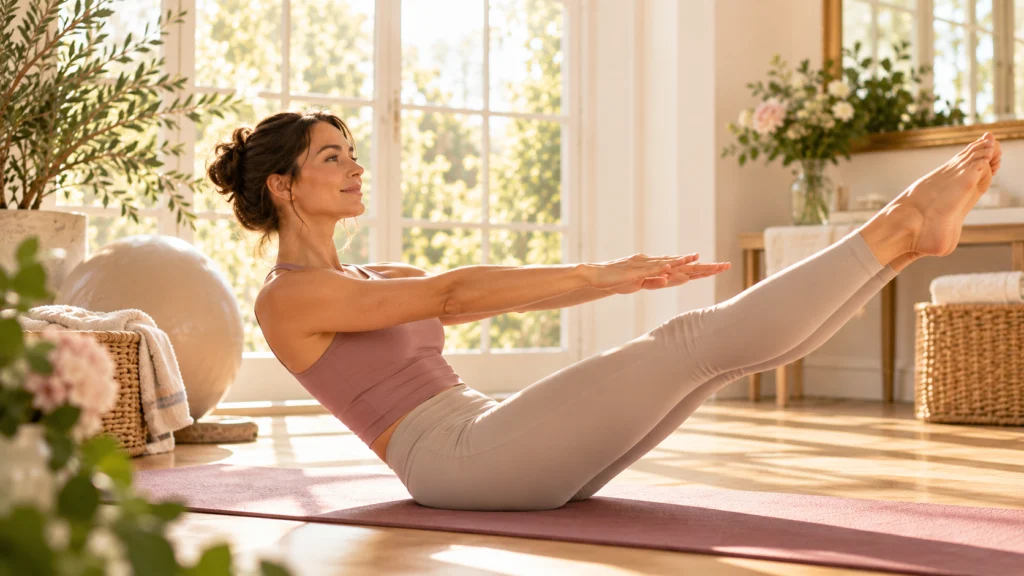
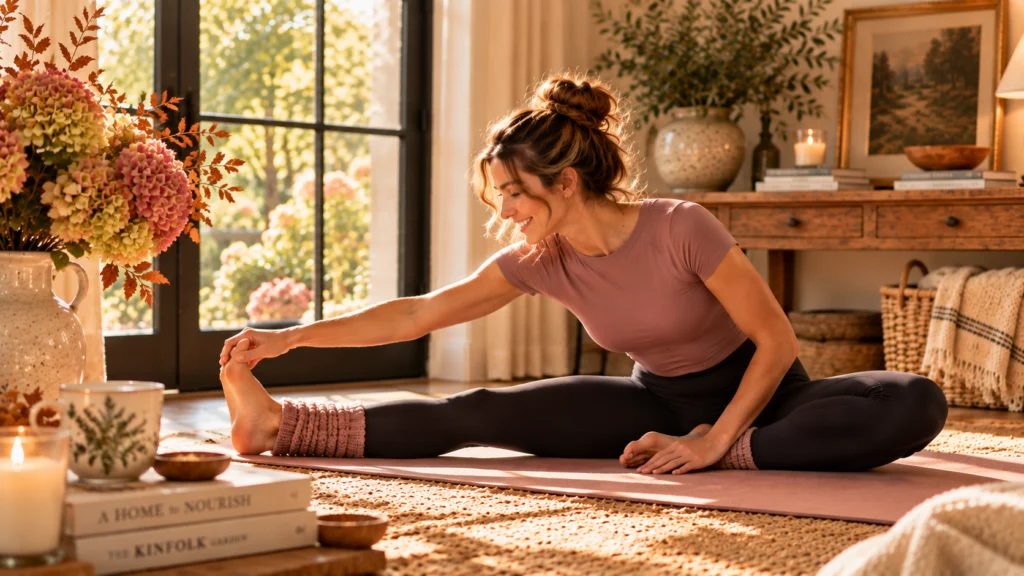
“Gosh, I could probably never take your classes. I’m not very flexible.” Our lead instructor hears some version of this all the time. And honestly? You must be kidding us with this, you guys! One of the beautiful things about Pilates is that you don’t have to arrive with a beautiful stretch, a perfect split, or the ability to casually fold yourself in half while drinking your morning coffee!
Pilates can actually help you build flexibility while you build strength—and that combination is one of the things that makes the method so wonderfully useful. In fact, Joseph Pilates himself believed that the muscles in your body should be evenly conditioned, in other words, not overlay bulky and not overly bendy! He also said “You are only as young as your spine is flexible,” which is one of my absolute favorite quotes of his. You can learn additional facts about Pilates and famous sayings from Joseph here. So if you’ve been quietly thinking, I should probably get more flexible before I start Pilates… Let’s clear that one up right now.
You Don’t Have to Be Flexible to Begin
Did I write that largely enough? Flexibility isn’t a prerequisite for Pilates. It’s something you can expect to build along the way. So, let’s get through some of the background. In simple terms, flexibility refers to your ability to move a joint through its range of motion. And range of motion can vary tremendously from person to person. Some people naturally have more available movement; others have less and there are many factors can play a role.
The important thing is that you can work with the range of motion you have today. What I think is especially fun and quite frankly, inspiring, is that over time, you can absolutely improve. The realization that your flexibility is getting better as you continue your Pilates journey is a wonderful one. Even if you’ve lost it a bit of your flexibility over time, or due to an injury, you can usually gain it back. I know a lot of our members used to do sports or arts quite intensively where they relied on great flexibility. It can be a bit humbling to try to get its back, but don’t give up, keep ‘stretching’ your limits.
The University of Michigan describes flexibility as the ability to move a joint through its full range of motion and notes that regular stretching can improve joint range of motion, reduce stiffness, and increase body awareness. In other words: you don’t wait until you’re flexible to start moving. It is movement that can help you become more mobile in the first place.
The Fittbe Way: Stretching That Moves
This is one of the things we love about Pilates. Rather than treating stretching as something completely separate from strength work, Pilates often asks you to move through a range of motion with intention and control. You might lengthen one part of your body while strengthening another. You might move into a stretch and then immediately use those muscles to control your way into the next exercise.
It’s not simply: stretch → stop → hold → done. It’s movement. And that matters because flexibility isn’t the only piece of the puzzle. We want to develop the ability to move well through the range of motion we have—and gradually expand that range as our bodies become stronger and more comfortable with the movement. The University of California, Davis recommends gradually increasing range of motion during flexibility work and emphasizes slow, controlled movement rather than bouncing into a stretch. That sounds rather Pilates-y to me!
Range of Motion: Your Body’s Beautiful Possibility
Here’s another distinction worth knowing for those of you with curious minds: Flexibility, range of motion, and mobility aren’t exactly the same thing. Flexibility generally describes the extensibility of muscles and surrounding tissues. Range of motion describes how far a joint can move.
Mobility is the broader picture: your ability to actively and effectively control movement through that available range. This is where Pilates gets particularly interesting. We aren’t simply interested in whether you can get somewhere. We want you to develop the strength and control to move there beautifully. That is a very different goal. Imagine lifting your leg. It’s one thing for someone to help your leg into a high position. It’s another thing entirely to have the strength, control, stability, and mobility to lift it there yourself. And that’s the Pilates conversation.
Your Breath Has Something to Do With It, Too
If you’ve ever noticed that a stretch feels different when you stop holding your breath, you’re onto something. Breathing gives you an opportunity to slow down, settle into the movement, and coordinate your body rather than fighting your way through it.
The University of California, Davis specifically recommends breathing during stretching and notes that breathing can support circulation and oxygen delivery to the muscles. So when your instructor says, breathe, she’s not simply filling the silence! She’s actually giving you another tool for moving well.
Try using your breath the next time you find yourself resisting a stretch. Instead of forcing yourself farther, take a breath. Soften your shoulders. Stay present and see what happens. Sometimes your body doesn’t need to be pushed, but rather to be given a little room.
And Then There’s Eccentric Control
Here’s a slightly more technical Pilates idea that we happen to love. Eccentric control. (and we don’t mean your kookie neighbor!) Again, for your curious minds – An eccentric muscle action happens when a muscle is producing force while lengthening. Think of slowly lowering yourself from a standing position, or controlling your leg as it lengthens away from you rather than simply letting gravity take over.
In Pilates, you’re constantly encountering this kind of controlled movement.
Why does it matter? Because we’re not interested in flexibility that exists completely separate from strength. In Pilates we’re interested in usable movement.
Try this in our next workout, instead of asking yourself, “How far can I stretch?” Ask yourself, can I control my body there? Can I support the movement? Can I breathe into it? Can I return with control? We want to move through the range we have without collapsing into it or using momentum? That’s where strength and flexibility meet, and why our Fittbe instructor is always saying “guide the movement”!
What the Research Says
There is actually some lovely research supporting the idea that you don’t need to begin Pilates already flexible.
A randomized controlled study conducted by researchers at the University of Dayton looked at 57 healthy college-aged women who were assigned either to a home-based Pilates program or a control group. After 10 weeks, the Pilates group demonstrated a statistically significant improvement in right hamstring flexibility, along with improvements in certain balance measures. The researchers concluded that Pilates practice resulted in gains in hamstring flexibility and balance, while also noting limitations that warrant additional research. We particularly love that this was home-based Pilates. You didn’t have to arrive at a fancy or already be flexible. You had to work at it and practice!
Other university research and educational resources similarly emphasize the relationship between regular movement, range of motion, flexibility, and strength. The University of Washington, for example, describes range-of-motion work as a way to help reduce stiffness and maintain joint flexibility, while strengthening exercises help maintain or increase muscle strength. That’s a pretty wonderful combination for a movement practice.
Why Strength Matters When You’re Building Flexibility
This is one of our favorite parts. Strength and flexibility aren’t opposites. They actually complement one another beautifully. Think about a rubber band. You don’t necessarily want it to be as loose as possible. You want it to have range, resilience, and control. Your body is considerably more complicated than a rubber band, of course—but the basic idea is useful.
A strong body isn’t necessarily a stiff body. And a flexible body isn’t necessarily a strong body. What we’re after is the lovely middle ground: strength + flexibility + stability + control. The University of Washington’s exercise guidance separates range-of-motion work, strengthening, and fitness into different categories, while emphasizing the value of maintaining both joint movement and muscular strength. Pilates brings those ideas together in one practice.
Pilates or Yoga: Which Is Better for Flexibility?
This is a question we hear, too. And there isn’t really a need to turn it into a competition. Yoga can absolutely be a wonderful way to explore flexibility and mobility. Pilates can help you develop flexibility, too—but it approaches movement through its own particular lens, with a strong emphasis on core control, alignment, muscular endurance, stability, and precise movement.
One isn’t necessarily “better.” They’re simply different practices with different traditions, structures, and emphases. If you love yoga, wonderful. If you love Pilates, wonderful. If you love both? Even better. Your body doesn’t require you to choose a favorite!
The Magic Is in the Combination
Here’s what we really want you to take away: You don’t need to choose between being strong and being flexible. In seeking total body balance, we want to be work toward both. This is why we’re so often talking about balancing our our musculature in our Fittbe Pilates classes on the apps. You can strengthen your core while stretching your hamstrings.
You can strengthen your glutes while opening your hips. Your arms can be toning up while you simultaneously develop beautiful shoulder mobility. You can build a foundation of stability as you’re gradually increasing your range of motion. And you can do all of it without forcing your body into positions it isn’t ready for. That’s one of the reasons we love Pilates so much! It’s not asking you to become someone else’s version of flexible. That’s why we’re always talking about how we feel in our own bodies. Pilates is asking you to become more capable in your own body, and that is certainly more useful, isn’t it!
Our Best tip is to Start
Maybe you can’t touch your toes. Maybe your hamstrings feel like they’ve personally filed a complaint. Maybe your hips are tight from sitting at a desk all day. Not to worry. The most important thing is to move slowly enough to feel what you’re doing.
You don’t want to bounce or force yourself farther simply because you think you should be able to go there. Expert guidance on flexibility consistently emphasizes gradual progress and controlled movement rather than forcing a range of motion.
And remember that progress in flexibility isn’t always dramatic. It really does take time, but trust me, you will progress! After a few weeks you might be noticing that your hamstrings or hips don’t feel quite so tight. Maybe you’ll feel able to reach a little farther. Before you know it, you’ll moving more comfortably, and performing those exercises we all love with a better balance of flexibility and strength.
A Little Goal for Your Next Pilates Chapter!
I really love goal setting. I love attainable goals, but to be honest I really like tackling a challenge as well. It depends on you, and how what you know about yourself in terms of goal setting. If you have a history of setting goals that are too lofty to meet, make your goal, “I want to improve my range of motion over the next 3 months. That might be easier and more targeted for you than instead of making your goal: “I need to become flexible.” Or maybe you give it a particular Pilates twist, choosing a goal like; “I want to build strength and flexibility together,” and I’ll do that by doing 4 Pilates workouts per week in my Fittbe app, and really focus on length an activation when she reminds me!
Now, you begin—and flexibility becomes part of what you discover along the way. So roll out your mat. Take a breath. And let’s let the Pilates repertoire do what it does best! The more you build your skills and balance strength and flexibility along with your mind-body connection, the more you’ll get more out of each class. It’s a win – win.
Make it a Fittbe Day.
Your favorite Pilates & Barre workouts, ready whenever you are.

Pilates • Barre • Good Living
Sources & Further Reading
The University of Dayton — The Effects of Home-Based Pilates in Healthy College-Aged Women
A randomized controlled study examining the effects of a 10-week home Pilates program, including hamstring flexibility and balance.
University of Michigan — Stretching and Flexibility
A helpful overview of flexibility, range of motion, and the role of regular stretching.
UC Davis Student Health — Get Started: Stretching & Flexibility
Guidance on gradual range-of-motion work, breathing, and controlled stretching.
University of Washington Orthopaedics & Sports Medicine — Exercise and Arthritis
An accessible explanation of range-of-motion exercise, flexibility, strengthening, and the importance of maintaining movement.