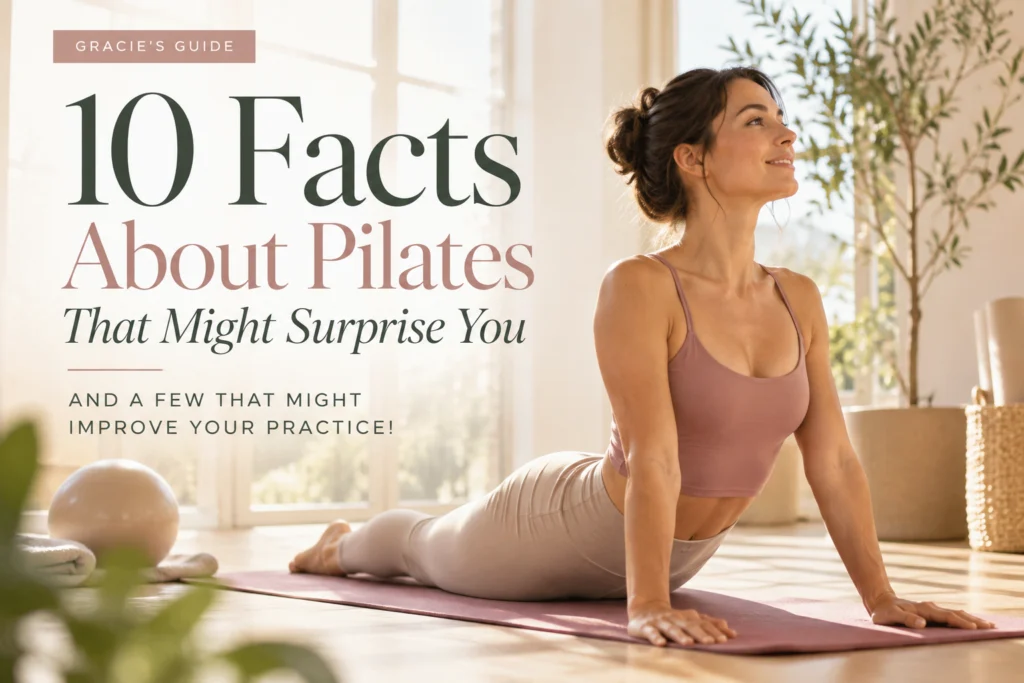
10 Facts About Pilates That Might Surprise You
And a few that might improve your practice!
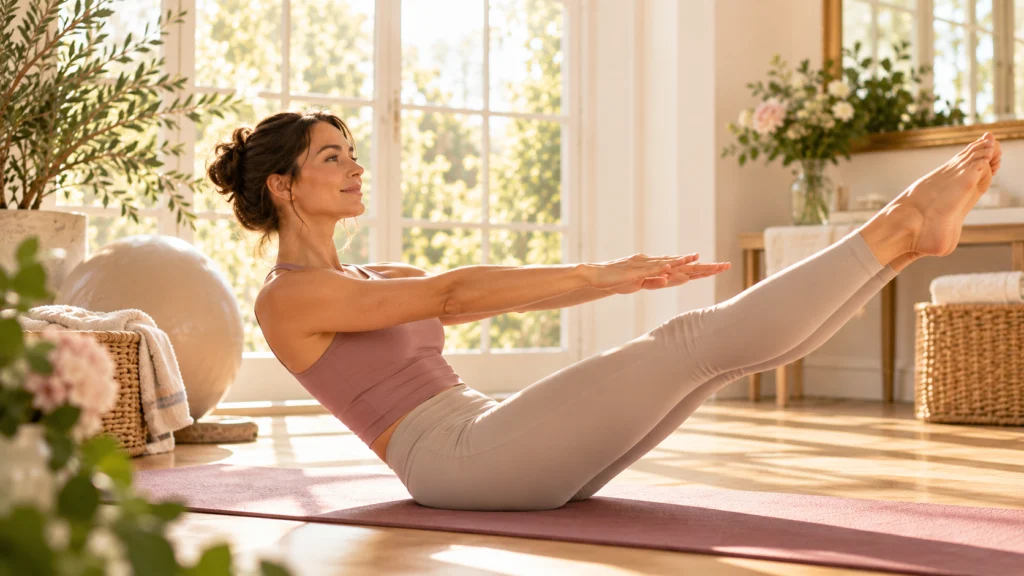
GRACIE’S GUIDE
Pilates has become so popular that most of us have a general idea of what it looks like: a mat, controlled movements, a lot of core work, and an instructor reminding you to keep your shoulders away from your ears! But there is quite a bit more to Pilates than meets the eye. The history of Pilates is fascinating, its terminology can be surprisingly specific, and understanding a few of the principles behind the method can even improve the way you practice. So, in the spirit of Gracie’s Guides, here are ten facts about Pilates that might surprise you—and, more importantly, might help you get a little more out of your next workout.
Pilates Wasn’t Originally Called Pilates
Joseph Pilates originally called his system Contrology. The name reflected his belief that physical movement should be guided by conscious control rather than simply performed by repeating a series of exercises.
The name Pilates came later, after Joseph Pilates developed and taught the system that eventually became associated with his name.
That bit of history gives us a helpful clue about the method itself. If you’ve ever wondered why your instructor seems very interested in exactly “how” you’re doing each exercise, this is part of the answer. Pilates isn’t simply a list of exercises to get through; the quality, precision, and control of the movement are fundamental to the practice.
Pilates Wasn’t Invented as an “Ab Workout”
This may be one of the most common misconceptions about Pilates. Yes, your abdominal muscles are going to get plenty of attention, but Pilates was developed as a whole-body system, not as a collection of abdominal exercises.
A good Pilates routine or session asks the arms, legs, back, hips, shoulders, and core to work together. It’s all about the beautiful combination of core strength and stabilization along with muscle balance, coordination, flexibility, whole-body awareness, and control. That’s why your Fittbe instructor says things like: even if you think you’re just doing a leg workout, you’re also doing a core workout!
Similarly, when your Fittbe instructor tells you to find your center, she’s not necessarily preparing you for forty minutes of crunches. She’s asking you to organize your body around a stable, supported center so that the rest of your movement can become more efficient and coordinated. Once you start thinking about Pilates this way, a lot of the exercises suddenly make more sense, and you are able to get more out of each!
The “Core” Is Much Bigger Than Your Abs
Speaking of the center, here’s another little misconception worth clearing up. Most of you know, if you’ve been one of our Fittbe members for a while, that our core isn’t simply your ab muscles. It includes a much larger network of muscles around your trunk, hips, and lower that help stabilize your body as you move. Think of it as your foundation for movement.
This is why a Pilates exercise can feel surprisingly challenging even when your stomach doesn’t appear to be doing anything particularly dramatic. You might be keeping your hips steady while moving a leg like in “leg circles,” stabilizing your ribs while moving your arms, or maintaining the organization of your spine while your legs are doing something entirely different.
The movement may be happening somewhere else, but your center is quietly doing its job. That’s one of the things I love about Pilates: once you understand how the pieces work together, you begin to see that an exercise can be doing much more than it appears to be doing.
Pilates Was Closely Connected to Dancers
This one has a particularly interesting history and is near and dear to my Fittbe heart! When Joseph Pilates opened his New York studio in the 1920s, dancers became an important part of his clientele. The method’s emphasis on strength, control, alignment, coordination, and efficient movement made it especially appealing to dancers and performers.
The Smithsonian’s National Museum of American History notes that Pilates opened his New York studio in 1926 and that dancers associated with figures such as Martha Graham and George Balanchine became among his clients.
If you’ve ever noticed that Pilates has a certain attention to the way movement travels through the body, this history helps explain why. Pilates asks you to pay attention to alignment, coordination, and the path of a movement rather than simply getting from point A to point B.
For anyone with a dance background, that connection can be especially fun to learn about. There is a vocabulary to movement, and once you start paying attention to it, you begin seeing details that were there all along.
“Low Impact” Does Not Mean “Easy”
This is one of my favorite Pilates misconceptions.
Pilates is generally considered a low-impact form of exercise, meaning that many of its movements place relatively little impact or pounding on the joints. But, that does not mean your muscles have been informed that they’re having a relaxing afternoon.
Controlled movement can be remarkably demanding. You know this Fittbe friends! Holding a position, slowing down an exercise, maintaining alignment, or controlling the return phase of a movement can create plenty of muscular work without jumping, running, or heavily loading the joints. That is why we commonly teach matwork alongside principles such as breathing, stabilization, and ribcage placement, and alignment.
So if you’ve ever finished a Pilates class thinking, We hardly moved. Why am I so tired?—now you know for certain. The work is happening in the details. Those details can be surprisingly challenging!
The Reformer Isn’t the Definition of Pilates
The Reformer has become so closely associated with Pilates that some people assume Pilates and Reformer are essentially interchangeable. They are not. The Reformer is one piece of the larger Pilates apparatus system. Pilates also includes matwork and other equipment, including the Cadillac, Chair, and barrels.
The original apparatus was designed to add resistance and assistance to movement, while matwork asks you to create much of the challenge using your own body and the floor. In Pilates we distinguish between matwork, props, and apparatus such as the Reformer, Cadillac, Chair, and barrel.
So if you love your mat, don’t feel as though you’re doing the “lesser” version of Pilates. Mat Pilates is Pilates, and it can be wonderfully challenging all by itself. In fact, having nowhere to hide from your own bodyweight can make a mat workout a very honest little experience. I actually think mat work can be the most rewarding and challenging method of Pilates.
Breathing Isn’t Just Something You Do Between Exercises
Pilates places unusual emphasis on breathing, and there is a reason for that. Breathing can help coordinate movement, organize the ribcage and trunk, and keep you from holding unnecessary tension while you’re concentrating on an exercise. In Pilates we commonly include breathing among the foundational principles of the method, along with stabilization, alignment, and control.
Here’s the practical part that can actually improve your practice: don’t treat breathing as another box you have to check. If your instructor gives you a particular breathing pattern, use it as a tool. Notice what happens to your movement when you inhale and exhale. Pay attention to whether you’re gripping your shoulders, jaw, or ribs while concentrating.
If you find yourself holding your breath during a difficult exercise, take that as useful information. You may not need to work harder; you may need to organize the movement a little better.
The Smaller the Movement, the More Important the Details Become
Pilates has a funny way of making an exercise look almost ridiculously simple. Then you try it, and suddenly the placement of your hips matters, your shoulders matter, your head matters, your breathing matters, and your leg is supposed to be moving there rather than three inches over.
That’s because Pilates is built around intentional movement, not simply completing a prescribed shape. Breathing, centering, concentration, control, precision, and flow or efficiency of movement are among the principles taught in Pilates.
This gives us a useful practice tip: when an exercise starts feeling familiar, don’t automatically switch into autopilot. Become curious about the details. Where is your weight? What are your hips doing? Are your shoulders creeping toward your ears? Can you make the movement a little smaller and more controlled? You may discover that an exercise you’ve done fifty times still has something to teach you. That’s one of the reasons Pilates can remain interesting for years.
You Don’t Have to Be Flexible to Be Good at Pilates
This one deserves a place on the list because it is such a common misconception.
Pilates can help develop flexibility and range of motion, but you don’t need to arrive with an impressive hamstring stretch to be a good Pilates student. In fact, research has found great improvements in flexibility among people practicing Pilates.
That’s a useful reminder that flexibility can be something you develop through practice, rather than something you need to possess before you begin.
For a deeper look at this subject, you might enjoy reading our Fittbe Journal article “Do I Need to Be Flexible to Start Pilates?” And if you’re currently thinking, Well, I definitely cannot touch my toes, don’t let that stop you. Your Pilates instructor has seen this before. We promise.
Getting Better at Pilates Isn’t Necessarily About Doing More
When we think about improving at exercise, we often assume we need to increase something: more weight, more repetitions, more speed, longer workouts. Pilates gives us another option. You can improve simply by becoming more precise.
You can refine your alignment, improve your breathing, become better at stabilizing one part of your body while another part moves, or make a familiar exercise smoother and more controlled. You can also learn to recognize the difference between something that is genuinely challenging and something that is simply being done with unnecessary tension.
This is one reason Pilates rewards consistency. A movement that felt impossibly complicated six months ago may eventually feel much more natural—not because the exercise changed, but because you learned how to organize your body for it.
And this is where Pilates gets really fun. The more familiar you become with the exercises, the more you can refine them. You start noticing the little things your instructor has been talking about all along—the placement of your ribs, the way your shoulders are working, the control in your legs—and suddenly an exercise you’ve done dozens of times feels completely different. You should keep going, Fittbe friends. There is always another layer to discover.
A Little Gracie’s Guide to Practicing Better Pilates
If you want to get more out of your next Pilates class, you don’t need to memorize every anatomical term or try to make every exercise look perfect. Instead, choose one detail to pay attention to. Perhaps it’s your breathing, the position of your shoulders, or the way your hips are stabilizing. On another day, slow down a familiar exercise and see whether you notice something you missed before. Pilates gives you plenty of opportunities to refine your practice without necessarily making the workout longer or harder.
And when you hear a correction in the Fittbe app, and you think, how does she know that!? Don’t think of it as evidence that you’re doing something wrong. Think of it as a reminder, because we can all get more out of each movement as we refine our skills. Pilates is a practice of learning how your body moves, and sometimes a tiny adjustment can completely change the way an exercise feels. That’s part of what makes the method so interesting: you can return to an exercise you’ve done for years and suddenly discover something you never noticed before.
So the next time you roll out your mat, bring a little curiosity with you. Listen to the cues, pay attention to the details, and don’t be afraid to make an adjustment when something isn’t quite working. That’s how you get better—and believe me, there is always something new to learn.
Want to Keep Exploring?
If you’re new to Pilates or if you’re a total pro, take a look at the Fittbe Pilates App to explore our Beautiful Movement classes and find a practice that fits your day. It includes a free trial that includes, of hundreds of workouts in Fittbe Pilates & Barre as well as a progress tracker that is totally different from other apps out there (you’ll see!), and
If you’re interested in the convenience of practicing at home, you might also enjoy our Fittbe Journal article Why Pilates at Home has Become a Comfort to Many!
In the mood for a little more history? Gracie’s Guide to The Great Schools of Ballet explores the different traditions, techniques, and movement languages that shaped classical ballet.
Make it a Fittbe Day.
Your favorite Pilates & Barre workouts, ready whenever you are.

Pilates • Barre • Good Living
Sources & Further Reading
Portland Community College — Pilates I
A university course description covering core strength and stabilization, muscle balance, coordination, flexibility, whole-body awareness, and control.
Read Pilates I at Portland Community College →
Texas A&M University — Pilates
An overview of Pilates matwork, breathing, stabilization, alignment, props, and apparatus including the Reformer, Cadillac, Chair, and barrel.
Read Texas A&M’s Pilates course overview →
Smithsonian National Museum of American History — Pilates Universal Reformer
A fascinating look at Joseph Pilates, his New York studio, and the early connection between Pilates and dancers.
Explore the Smithsonian’s Pilates history →